

Want to know how to photograph horses? Read on.
I’ve been photographing horses professionally for 35 years, working for Land Rover, British Eventing, Horse & Hound and many more. These 11 techniques are what I actually use in the field, not theory from a textbook.
I am regularly asked for tips on how to photograph horses, so it’s time I got round to answering the question online.
Photographing horses is not a straightforward exercise, but if you understand why then things improve very quickly.
It should be noted that I am writing about how to photograph horses in a competition or working environment and not fine art style equine portraits. Some of these tips will apply to both but with the latter you can get away with breaking the unspoken rules!
Learn equestrian photography from someone who has spent 35 years doing it professionally
Most equestrian photography courses teach equine portraiture and little else. This membership covers the full picture — dressage, eventing, showjumping, hunting, reining, vaulting and more — because real equestrian photography happens across every discipline, in every kind of light, at every level of competition.
These are the same methods I use working for clients including Land Rover, British Eventing, and Horse & Hound. Short focused courses and longer deep dives, all in one place, for a single one-off membership fee.
The membership is currently available at a significantly reduced founding rate while the full course library is completed. This price will not last.
Before You Start – Understanding How Horses Move
As with a lot of sports photography, knowing what is going to happen is a huge advantage. Anticipating what a horse is likely to do next is much better than relying on reactions.
Also, taking your photographs at the flattering moments in a horse’s movement is the difference between success and failure.
Camera settings for horse photography
The one that matters most – shutter speed
If we use a shutter speed which is too low, then no matter how good we are at panning (moving the camera with the horse) we will see blurring in our images, caused by the slight movement of the horse while the shutter was open.
Different equine disciplines require different shutter speeds. Dressage and jumping actually allow for a slower shutter speed than perhaps something like polo or horse racing, where the horse is covering the ground much more quickly.
First, make sure your camera is in manual mode (M). This isn’t as scary as you think.
Set your shutter speed at 1/1000 to start with. We will change the aperture in the next section.
Most of the time we want to freeze the movement of the horse, but there may be times when you deliberately want blurring to give the impression of movement. If this is the case then you can take the shutter speed down to 1/320s, which is nice for creating the sense of speed in racing photos, 1/125s for polo and so on. You must experiment. Then you can move your ISO lower to compensate.
Why I shoot manual, not Aperture Priority
We are interested in the horse and not the background so we set a nice wide aperture to reduce the depth of field. Having said this I rarely shoot with the lens wide open because there is normally a drop in quality here which can be avoided by dropping a stop or so.
If you are outside then set your aperture to something like f4 to f5.6, then change your ISO until the meter in your camera says the picture is exposed correctly, or if it looks right in the viewfinder if you are using a mirrorless camera.
Double check you exposure by taking a shot of the scene before the horse gets there. Adjust if necessary. Higher ISO to brighten the image, lower to darken it.
You are now set up to shoot away and it won’t matter what colour the horse is because you exposure is set. Obviously if the light changes you will have to repeat these stages.
Continuous Autofocus – non-negotiable
The camera needs to be able to focus even as the horse is galloping/trotting/jumping so we must set the camera to use continuous autofocus. Finding the setting for this varies from camera to camera but on Nikons the setting you want is “AF-C” as opposed to M (Manual) or S (Single). You’ll notice that this also stops the camera from beeping when it focusses which is a very good thing. When you switch back to normal “servo” mode autofocus for something else consider turning that beep off. You will almost never hear a pro with that sound still switched on and if you do they tend to be the subject of some light-hearted banter!
For a full breakdown of camera settings, bodies and lenses, read my dedicated guide to camera settings for horse photography.
Positioning Yourself for the Best Shot
Sun position and light direction
Positioning yourself can make all the difference between a good shot and a poor one. As a general rule you should shoot with the sun behind you, especially if it is a sunny day. There are many who would argue that this is not a strict rule, and I would agree that there are some great opportunities to be had with backlit subjects (“golden hour” portraits, horses in water), but to ensure that you can see details in the shadow areas it is more reliable to keep the sun over your shoulder.
Where to stand for dressage and flatwork
For dressage or other flat ground shots then somewhere between head on and sideways on is ideal. Sideways is better for showing the whole horse (more of this a little further down the page) but some great head-on shots can be had too.
The 45-degree “rule” for jumping
Similarly for jumping I would take most shots from somewhere around 45 degrees from the axis of the fence but would also take them from closer to side on and rarely completely head on.
Why you should never shoot from behind
There is almost never a reason to take your shot from behind the rider. It’s not flattering to horse or rider.
Timing – The Most Important Skill in Horse Photography
Timing makes a good equestrian photograph, of that there is little doubt. There are certain stages in a horse’s movement which are good to capture because they show off the horse’s musculature and scope well and others which are unflattering in the extreme. Some will argue that some of these are very subjective but please comment if you have other suggestions but there is an unspoken etiquette which hopefully I can share.
Photographing horses at trot – the M-shape moment
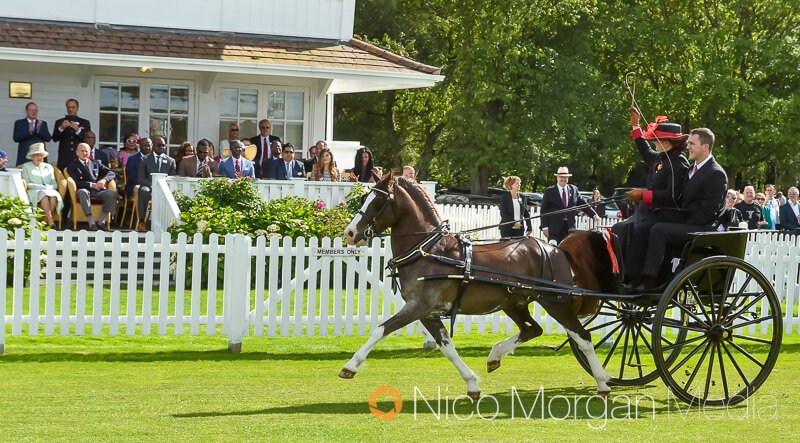
when photographing horses at the trot there is only one moment to capture and that is when the foreleg nearest you is fully extended. This should result in the legs forming an “M” shape:

In the UK we would never offer an image of a trotting horse for sale if it was not in this position. In the US they are more flexible and seem to often take the exact opposite image, where the nearest legs are together in the middle and the furthest legs are fully extended.
Canter and Gallop – which leg leads
Likewise when photographing horses in a canter you must be on the same side of the horse as the leading foreleg, which means being on the opposite side of an arena or show ring to the horse. Again this leg should be extended when you press the shutter:

Both of these examples were taken side-on but it’s perfectly acceptable to shoot from slightly further in front of the movement. You should avoid photographing horses from behind.
The perfect Jumping shot – before, during or after?
There is more scope when it comes to photographing horses jumping and everybody has their own personal taste. I feel that there are two really good points at which to press the shutter. The first is just before the horse reaches the high point of the jump – back legs should be fully extended and forelegs neatly tucked in. We don’t want the back legs on the ground and bent, nor do we want to delay it too long and let the forelegs separate from the body too much. The point in the jump when both fore and hind legs are half bent is what I call the “clothes hanger” and is very unflattering. The second point at which to click is just before the horse touches ground again. The front legs are fully extended and the back legs stretched out behind.

There is another point to choose if you are lucky enough to be photographing good quality show jumping. Because of the great heights they jump there is a wonderful point in mid jump when all four legs are pressed hard against the horse’s body to keep them out of the way of the poles. If you can catch this moment it can look rather impressive.
Caveat: If you browse my galleries you will see that I break my own rules quite regularly, particularly when it comes to taking more than one image “on the way down”. I also tend to keep the ones where I got the timing slightly wrong because it is a question of taste and if a rider likes it then that is good enough for me.
Exposure and Metering for Horse Photography
When this article was first published it was squarely aimed at users of DSLR cameras, where what you saw through the viewfinder was not the exposure you got when the picture was taken.
Now that many cameras, even at entry level, are mirrorless, we can use the image we see through the viewfinder to judge whether the image is correctly exposed (I wouldn’t recommend judging your exposure using the LCD screen on the back of your camera because ambient light might make that confusing).
With a DSLR you must understand a little about metering.
Camera meters are calibrated to something called 18% grey, or “mid grey”.
If you point a camera at a dark object the camera tries to lighten it. The reverse is true when you point a camera at a light object – it darkens it to get to mid grey.
Why Grey horses fool your camera
A “grey” horse is generally whiter than mid grey, so your camera will try to make it darker if you allow it to.
Why Black horses also make it harder
All darker horses have the opposite effect and the camera tries to make them lighter.
Manual metering vs Aperture Priority
If you are using manual metering (and I have to admit that even with the quality of the metering in my cameras I do shoot mostly in manual) then take some test shots of the place where your competitor will be and adjust your exposure and ISO until you are happy that the histogram on your camera shows a good spread of values from blacks to whites without too much “clipping”, or bunching up, at either end.
If the idea of shooting in Manual (M Mode) is too much at this stage, and you prefer to shoot in Shutter Priority or Aperture Priority, then you will have to use the exposure (+/-) button to deliberately adjust the camera’s metering to allow for the colour of the horse.
If you are using a mirrorless camera then what you see is what you get. Point your camera where you want to take the picture and adjust your settings until the image looks like the real thing in your viewfinder.
If it’s too bright you can use either the shutter speed (up) or ISO (down) to darken it.
If the scene is to dark then I suggest only using the ISO (up) to brighten it – we want to keep the shutter speed where it is most of the time.
Exposing to the right – what it means for horse photography
If you arein any doubt about whether the image should be brighter or darker then go for brighter. Camera sensors store more info at the highlight so it may be recoverable.
More on the subject of “exposing to the right” can be found on the web elsewhere.
More Advanced Techniques
Back button focusing – what is it and why it matters for horse photography
Most photographers use the shutter release to start the autofocus system of their camera, but for various reasons, especially when I’m photographing horses, I use a separate button on the back of my camera to manage autofocus before releasing the shutter in the normal way.
Why? Well in some situations I am photographing horses and there are objects between me and the horse and rider which can confuse the cameras autofocus system at just the wrong moment. For example, in most show jumping arenas there is a lot of woodwork, greenery and general decoration around the jumps. If I was positioning my focus point on the horse, pressing the shutter release down half way, and then panning with the horse as it jumps, then there is a chance the focus point will move over something in front of the horse, the top of a jump wing for example, and focus on that at the vital moment.
Instead I look at the jump first, focus on the point I know is the same distance from me as the rider will be mid-jump, then release the shutter as usual, knowing that the camera is not focussing on the wrong thing.
Back button focusing used to be something I turned to in some situations, but now is the default set up for my camera. How you program your camera to use a back button and not the shutter release will vary between models, so you will need to refer to your camera’s manual.
Why I don’t use Continuous Shooting mode
In short, make sure your camers is not on high-speed mode. There are at least three reasons for this.
First, you should be picking the best spot to freeze the action yourself, not hoping that one of your 4-20 frames will get it if you’re lucky. See the ‘Timing” section earlier.
Second, the sound of a camera in continuous shot mode can be very off-putting to the competitor and distracting to the horse. One pro I know nearly got himself ejected from a big dressage competition because he started machine-gunning in the middle of someone’s test! I know most modern cameras are almost silent but not completely.
The third reason is a very practical one: your camera’s shutter has a limited life and the more you use it the sooner it will need to be replaced at some high cost! This is less important now with the era of electronic shutters.
Shoot RAW
When you can, shoot in RAW mode. Your camera will store a lot more valuable information about each shot you take and, should you make a mistake, then having that information available is a godsend. It’s not always possible. You may not have the time or the much greater storage space required to keep the RAW files but do so if you can.
However, if you’re lucky enough to get some experience shooting for an equine event photographer – and I suggest you do if you can – then absolutely DO NOT shoot in RAW. They may kill you.
Panning
One of the biggest mistakes photographers make with any (fast) moving object is not panning. We want the subject of our shots to be the focal point of our image and to achieve this we must move the camera lens as the horse passes, keeping it where we want it in the frame even after we have pressed the shutter. The other benefit of panning is that the horse is moving more slowly relatively to the camera and it more likely to be sharp as a result. If you are photographing horses with a slowish shutter speed (indoors for example) then this is very important. A nice effect can be achieved by deliberately using a reasonably slow shutter speed and panning with the horse so that parts of it blur to give the impression of movement while other parts which have remained still relative to the moving camera, appear quite sharp.
Move your focussing point
Most modern cameras allow you to move the point on which the camera focusses and this is very important as the eye of the viewer will be drawn to the sharpest area of the image. It is easy in a studio or with a stationary object to focus on the most important area, hold the shutter button half down while you re-compose and then tae the shot. You can’t do this with a moving subject, especially as we are in continuous focus mode! Instead we have to think about where the subject of the shot will be in the finished image and choosing a focus point, if possible, in that area of the viewfinder.
The one last point I would like to make is that photographing horses is about the horse first and the rider second. As a photographer at The Horse of the Year Show one year, I overheard competitors in the ring telling the official photographer “Not me, the horse!” which I think sums this up.
Photographing Specific Disciplines
For each of these disciplines we want to keep the shutter speed high. These tips are more to do with timing and position.
Showjumping photography
The most flattering images of showjumping are taken over parallels (oxers) and not uprights. The horse makes a better shape. When you approach a course for the first time you will want to see if there is a spot which puts you in direct sight of several oxers first.
As I previously suggested, we want to shoot from between side-on and close-to-but-not-completely head-on. For editorial use it would be more head on (to show rider’s face) but for the best overall image somewhere around 45 degrees is a good starting point.
The photograph we want is at the high point of the jump, where the front legs are tightly tucked in.
Examples: Showjumping photography
Cross Country Photography
I didn’t say eventing cross country because there are hunter trials, hunt races, and so on to which these guidelines apply too.
Timing is the same as for showjumping, at the high point over most jumps, on the way down if it is a drop fence.
We want the jumps to look as big as possible. Include the whole jump in your shot and shoot from a low angle if possible, NEVER from above.
Examples: Eventing photography, Hunt ride photography.
Dressage Photography
You may not get much choice about where to stand to shoot dressage, but if you do, a third of the way up one side is a good starting point, depending on the test.
The “money shot” in dressage is the medium or extended trot shot with the nearest foreleg to the camera fully extended. Other popular ones are the high point of the movement during an extended canter.
Hunting Photography
Very similar to cross country photography.
We want to make the fences/hedges looks big so low angles from the landing side (if you can) at around 45 degrees.
High point, or on the way down, but nothing touching the ground.
Point-to-point and Racing photography
In front of the fence is normally better, unless you want to experiment with remote cameras attached to the wings.
High point and on the way down. Tidy legs if possible.
Examples: point-to-point racing photography.
Conclusion
The key to photographing horses is this: if the horse is not looking good then the image is not successful. You should never deliberately amputate a horse’s limb at the capturing or cropping stages (I wish some major picture agencies would take note of this), nor should you keep an image if the horse looks uncomfortable or unhappy.
I hope this is useful to some but please comment below if you disagree. I would welcome a discussion.
Further Reading
- Equine Portraits 101 – A primer for getting started with equine portraits
- The best websites for photographers – How to present your images online
- 11 “Rules” of equestrian photography – which photos of horses work and which don’t
- How to shoot jumping hoses in low light – how to deal with shooting in low light
- Camera Settings for horse – some professional tips.



4 comments
Bennett
Hello,
Thanks a lot for those tips!
Last year, I shot horse riders during an open day of the riding stable of a friend of mine. She was happy with the pictures (I was too!) but, a few weeks after, she told me it could have been even better if I had not knelt to shoot next to hurdles (not sure of this word!). She told me the hands of the horse riders were too visible, too “attention catching”. I personally did not agree with this opinion, but I am not a professionnal for this kind of pictures.. What do you think about it?
Nico
I would agree with you!
Swanky
Hi,
I have really appreciated the articles you have written and have come back to them time and again for refreshing my brain.
I normally shoot with the AF on the trigger button along with the metering. I am trying out back button, particularly because I have had a few occurrences where the AF has jumped from the horse while I was panning, it leapt from the horse to the wing of the jump and back again, but by then it was too late and the shot was lost. I think, even though it was on track subject ignoring possible objects (Canon) because I had it set to recognise animals, it mistook the fir branches as mane (Working Hunter), thus losing the focus.
My question, in attempting back button, is that you say this in this article –
“Instead I look at the jump first, focus on the point I know is the same distance from me as the rider will be mid-jump, then release the shutter as usual, knowing that the camera is not focussing on the wrong thing.”
Do you focus on that point and wait, trusting the 1/1000 shutter will freeze the action, or do you pan still as the focus should remain locked so when you get to that point it will still be in focus?
Many thanks for sharing your knowledge it has been invaluable to me as a new event photographer.
Kym
Nico
Hi Kim
My fault. I didn’t specify. I meant that if the scene is really busy and there is any chance of the camera focussing on the wrong thing I will pre-focus, then pan with the horse and time my shutter release in the usual way. The exception to this would be with remote cameras. Because they can’t pan I adjust my settings to give me more depth of field and faster shutter speed, at the cost of ISO.
To avoid what is happening to you I would generally not trust something like subject tracking, preferring instead to fix the focus point and then pan with the horse keeping that spot where I want it, depending on the angle.
I hope that helps.