
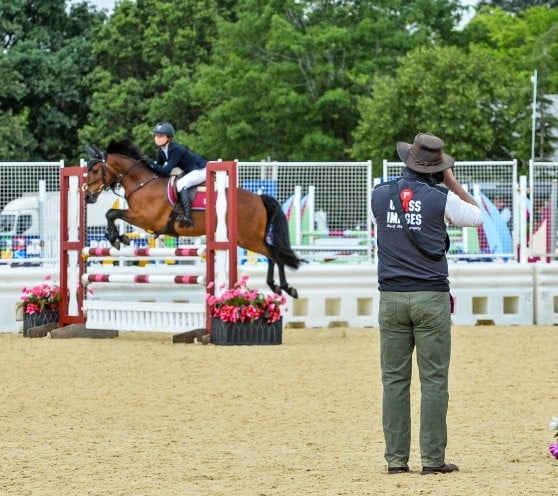
There is a version of this post that opens with something like “equine photography combines two great passions.” You have read that post. It is on approximately forty different websites and it tells you nothing useful.
This one is different. I have been a full-time professional equine photographer for 35 years. I shoot at least two disciplines every week during the season, sometimes three or four. I have worked at Burghley, Badminton, Blenheim and pretty much everywhere else too. My images have been published in Horse & Hound, The Telegraph, Country Life, the BBC and about a hundred other places. I am telling you this not to impress you but to establish that what follows is based on actual experience, not research.
So, can you make a living from equine photography? Yes. Is it easy? No. And the reasons most people fail have very little to do with photography.
Can you actually make a living from it?
Yes. A full-time equine photographer working hard across multiple income streams can earn anywhere between £30,000 and £100,000 a year in the UK. That range is wide because the job is wide — there is a significant difference between someone doing weekend event photography on top of a day job and someone running a full commercial operation.
I will be honest about the ceiling too. Earning above £85,000 or so means you are into VAT registration territory, which is its own administrative world. Most working equine photographers are somewhere in the £30,000–£60,000 range. That is a decent living. It is not a lottery win.
What it is not, under any circumstances, is passive. There is no version of this career where good images appear in people’s inboxes and money comes back the other way without significant effort on the business side. If that surprises you, read on.
The work itself — what are you actually selling?
Equine photography is not one job. It is several, and most professionals who do it well are doing at least two or three simultaneously. Here is how they break down:
Event photography for companies. This is where a lot of people start. An event organiser — a horse trials, a showing society, a hunt — hires you to cover their day. You deliver images, they use them for press, social media and their own archive. Day rates vary considerably but it is structured, regular work during the season.
Event packages sold direct to riders. A different model. You attend an event, photograph competitors, and sell images directly to the riders themselves. Higher potential income per day but entirely dependent on volume, your ability to get round a course quickly, and whether riders actually buy. Many don’t — more on that shortly.
Portrait photography. Horse and rider portraits, yard sessions, that kind of thing. Higher per-shoot rates, more editing time, fewer clients per week. Some photographers build their entire business on this. It suits a certain personality and a certain approach to the work.
Editorial photography. Supplying images to magazines, newspapers and online publications. Horse & Hound, The Field, Country Life, the equestrian press broadly. Can be commissioned or sold from an existing archive. Lower individual fees but it adds up and the publication credits are worth something in their own right.
Commercial photography. Shooting for brands — equine supplement companies, saddlery, clothing, luxury products that want horses in the frame. This is the highest day-rate work in the industry and also the hardest to break into. It requires a different skillset and a portfolio that speaks to art directors, not just horse people.
Teaching and education. Once you have a body of knowledge worth sharing, this becomes a genuine income stream. I run a membership for equestrian photographers and it is — without question — the most scalable part of what I do.
Most photographers mix several of these. On one day at a three-day event last summer I was shooting for two commercial clients alongside editorial coverage and sold a rider package on top of that. Four income streams from one day. That is not unusual once you have the operation running properly.
Why most aspiring equine photographers never make it pay
Last year I had lunch with two very well-known event riders at Burghley. I asked them what arrangements they had with the photographers who were regularly supplying images for their social media.
“Oh, they just send them to me for nothing,” they both said. Both of them. Different photographers in each case — photographers who are not beginners, who know better, and who were, incidentally, breaking the terms of their accreditation by doing it.
This is the single biggest problem in equine photography. Hobbyists — and some people who really should know better — share hundreds of unwatermarked images on social media, give them freely to riders, and offer work to publications for “exposure.” What this does, over time, is train the entire market to expect free photography. The rider gets used to a steady supply of images at no cost and has no reason to pay. Other riders see this and assume that is how it works. The photographer who wants to charge professionally is suddenly the unreasonable one.
Here is somethign else I wrote on the subject: https://nicomorgan.com/why-you-should-not-give-away-your-images/
If you want to make money from equine photography, you have to value your own work before anyone else will. That means watermarks on everything that leaves your hands before sale. It means not sending free images to riders because they are famous or because you want to be associated with them. It means understanding that every free image you give away makes it marginally harder for every professional in the industry to charge what the work is actually worth.
None of this is popular to say. It is still true.
What you actually need to get started
Everyone writes a gear list at this point. I am not going to do that, because gear is the easy part — you can look up what lens to buy in about four minutes. What you cannot Google is the rest of it.
You need to understand horses. Not just like them — understand them. You need to know what a horse is about to do before it does it, because by the time it does it the moment has gone. You need to read a dressage test well enough to know when the extended trot is coming. You need to know which fence on a cross-country course produces the best photograph and which one just looks good in the brochure. This knowledge takes years to acquire and there is no shortcut.
You need to be comfortable moving around horses without either alarming them or getting hurt. Yards, warm-up rings, collecting rings — these are working environments with large animals and other people trying to do their jobs. If you are nervous around horses it will show in your work and it will make you a liability.
You need the business basics. A proper pricing structure. Watermarked proofs. A gallery platform that lets you sell online. An understanding of image licensing and what you are actually selling when someone buys a photograph. And — critically — the ability to have a professional conversation about money with clients who would rather not have it.
As for equipment: a body with fast, reliable autofocus and a 70-200mm f/2.8 lens will cover the majority of what you will ever shoot. Everything else is refinement.
Is it seasonal — and what do you do in winter?
Yes, unambiguously. The British equestrian calendar runs roughly April to October for most outdoor disciplines. From November through March the number of paid events drops sharply, the weather makes outdoor portrait work difficult, and the editorial commissions slow down.
This is not a problem if you plan for it. It is a serious problem if you do not.
Winter is when I focus on stock image sales from the year’s archive, editorial licensing (images already shot and sitting on the server earning money), updating the membership content, and web design work — which I do alongside photography. Some photographers use the off-season for commercial work, studio-based portrait sessions, or teaching.
The photographers who struggle in winter are the ones who treated the summer as their only income period and spent it accordingly. The ones who do well treat it as the production period that funds a different kind of work over the winter months.
How long does it actually take?
If you are starting from scratch — some experience with a camera, a genuine love of horses, no existing client base — getting to a point where photography earns you meaningful money takes around two to three years. Getting to a point where it could replace a full-time income takes longer, and most people do it in parallel with other work until the tipping point arrives.
That is not me being discouraging. It is just true. A realistic timeline prevents the abandonment that happens when people expect results in six months and do not get them.
The photographers who get there fastest are invariably the ones who treat the business as seriously as the photography from day one — not the ones with the most expensive kit.
Where to go deeper
This post is an overview. If you are serious about building equine photography into a career, the detail — specific tactics for event packages, how editorial licensing actually works, how to get accreditation, Lightroom workflows, positioning in a market full of people giving work away — is what the membership is for.
You can see what is inside The Equestrian Photography Membership, including a post that covers the seven main income streams in depth for anyone who wants more than an introduction.
Nico Morgan is an equine and commercial photographer based in Leicestershire with 35 years of professional experience. His work has been published by the BBC, Horse & Hound, The Telegraph, Country Life and many others.


Comments